
Self-hosted media server
Your library.
Every screen.
Playarr turns the media you already own into a properly catalogued, genuinely watchable library, self-hosted on the server you run, and on the phone in your pocket, the tablet on the sofa and the television in the corner.
Free and open source under the MIT licence. No account with us, no telemetry to opt out of, no tier that unlocks your own hardware.
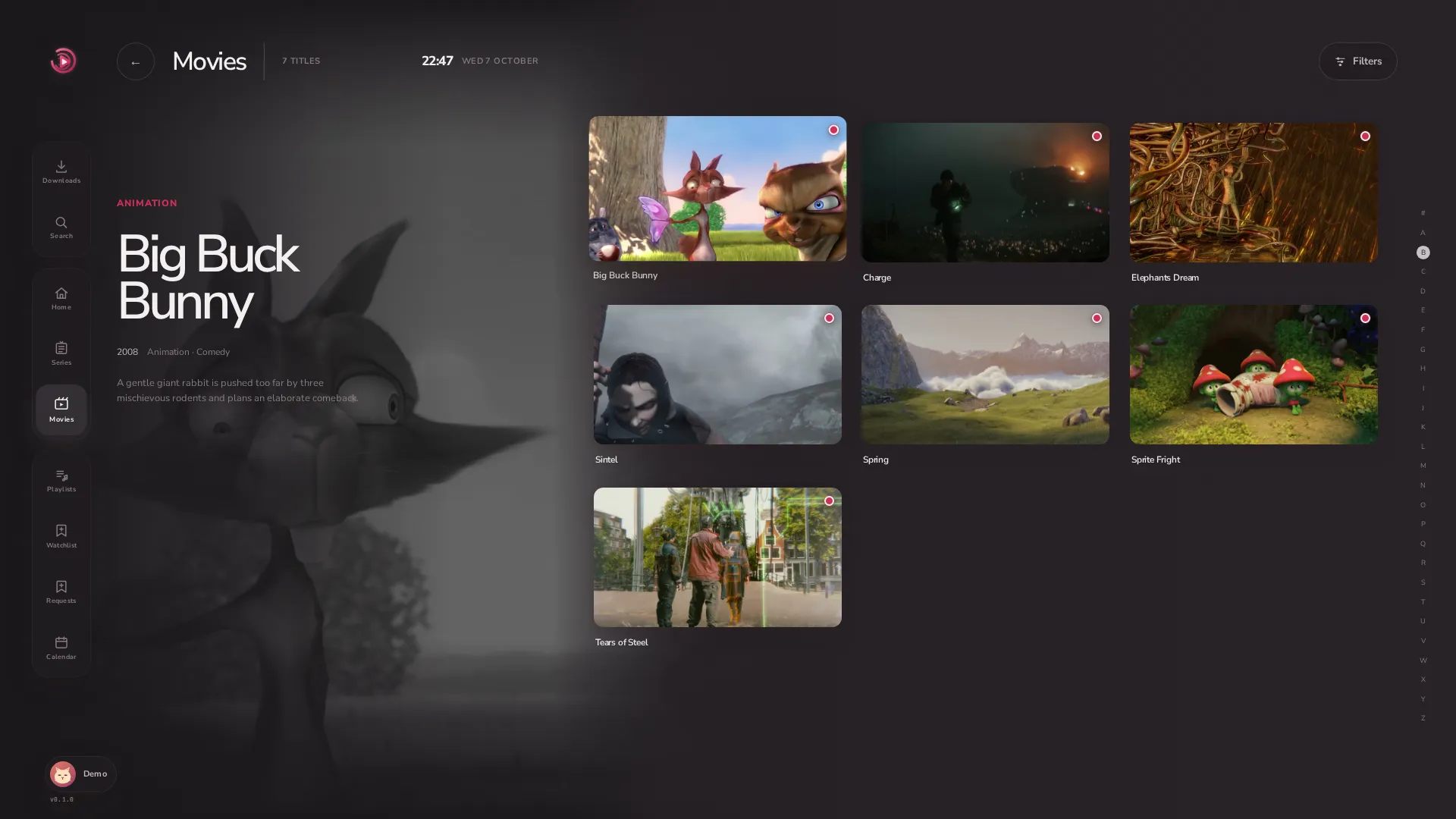
Screenshots show a demo library of openly licensed Blender films (CC BY, credit to the Blender Foundation and Blender Studio; full attribution), not anyone's personal collection.
What it is
The playback layer your setup is missing
You already have the storage and the tools that keep it tidy. Playarr is the part that makes it a pleasure to actually watch.
One library, properly catalogued
Films, series, music and books in a single catalogue, with posters, backdrops, cast and crew, chapters, subtitles and multiple audio tracks, matched against the identifiers your library tools already resolved.
Plays on the hardware you own
Direct play with real seeking wherever the file already suits the screen, and server-side transcoding with a quality ladder when it does not. Library-wide re-encoding runs as a separate, lower-priority system that yields while people are watching.
Accounts that fit a household
A profile picker with PINs and avatars, and library access that is denied until granted. Being an administrator does not silently make you a viewer, the two are separate grants on purpose.
Your server stays yours
Self-hosted from the first byte. Nothing is brokered through a third party, there is no account to create with us, and the whole HTTP API is a published, generated OpenAPI contract you can build against.
A closer look
What the interface actually looks like
The real interface, populated with a demo library of openly licensed Blender films, not a personal collection.
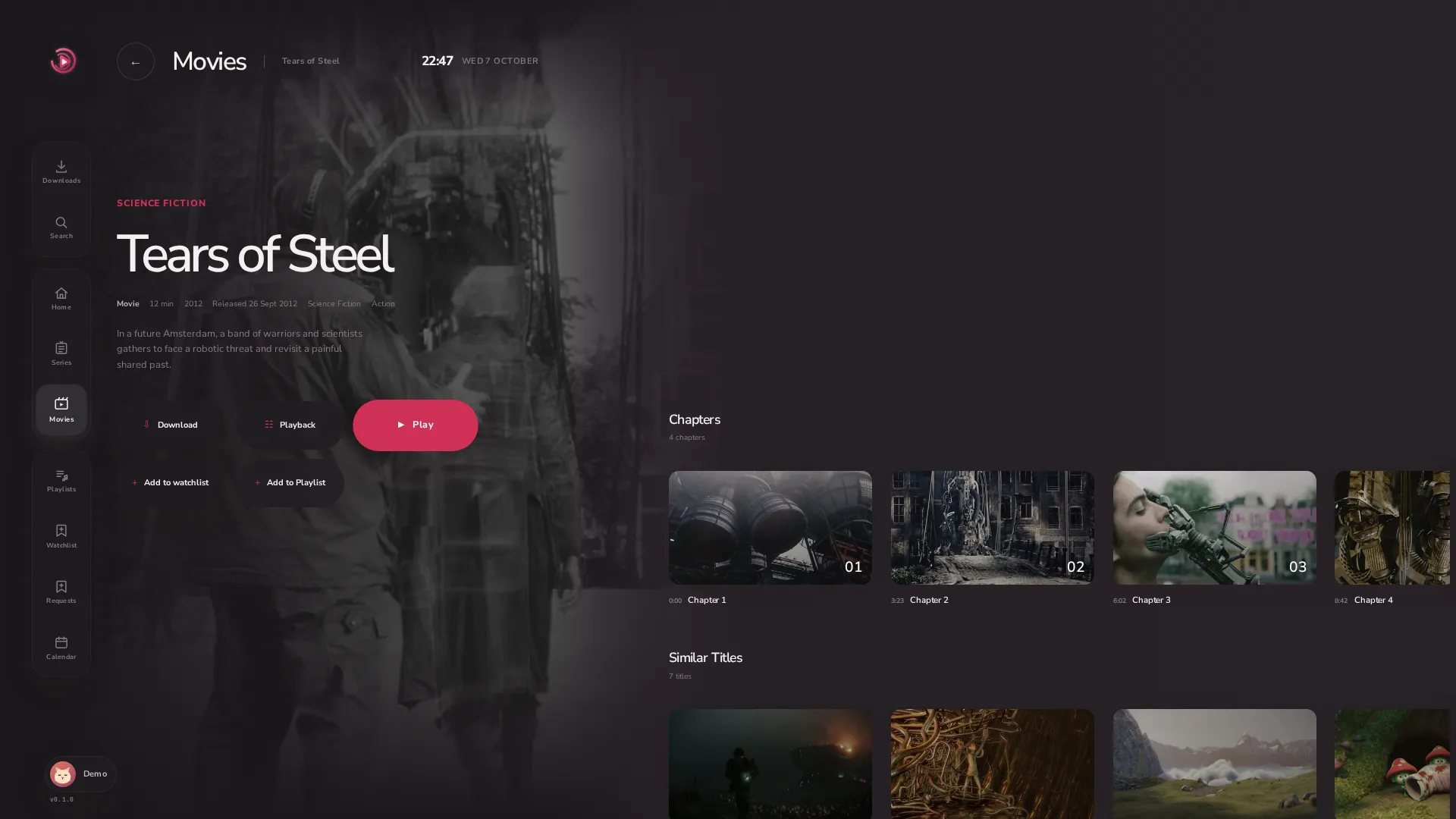
Every title, properly presented
Chapters, cast, runtime and a "similar titles" rail generated by a local embedding model, no cloud call involved.
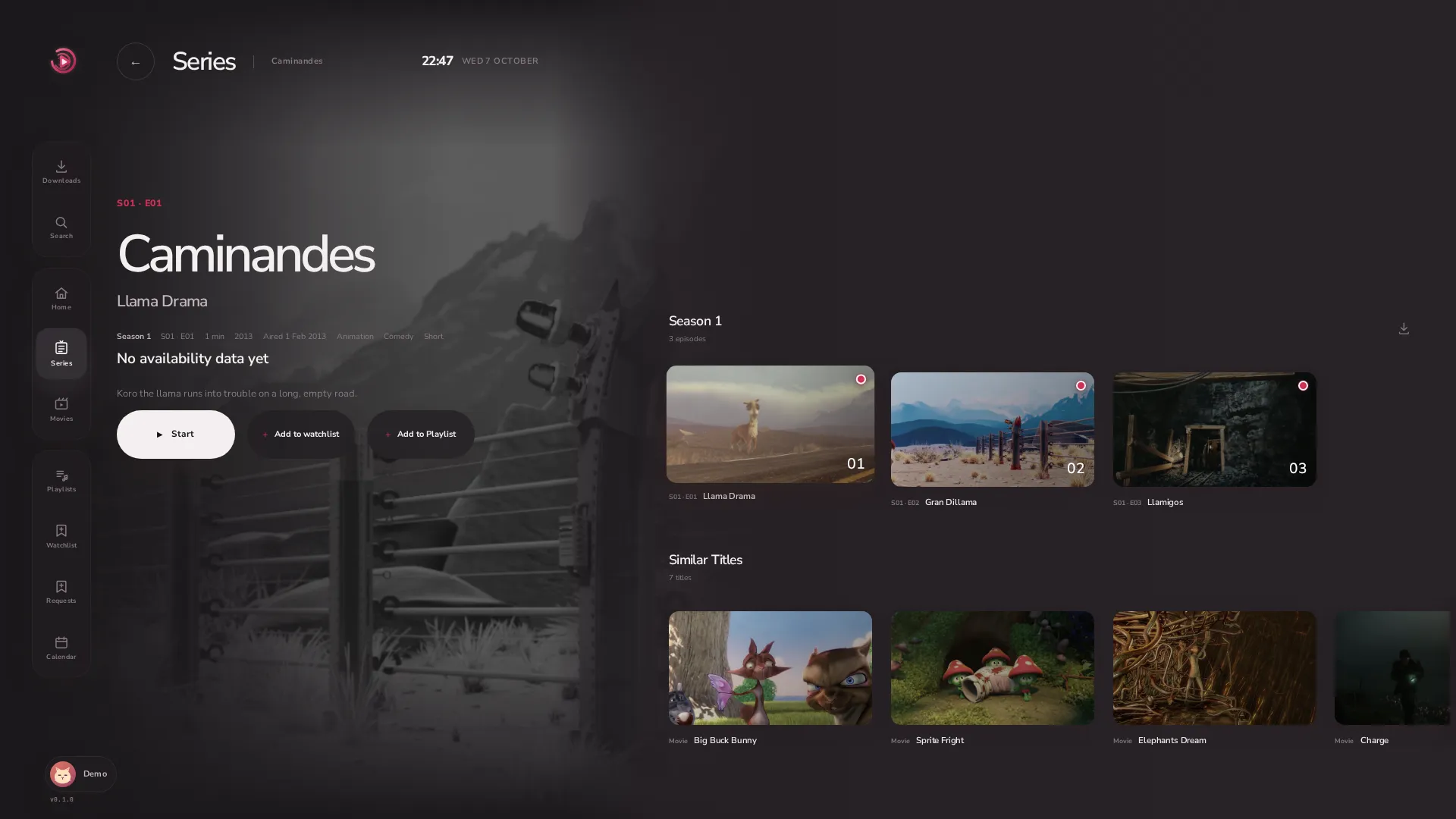
Series get the same treatment
Seasons and episodes sit in the same catalogue as films, music and books, matched against the identifiers Sonarr already resolved.
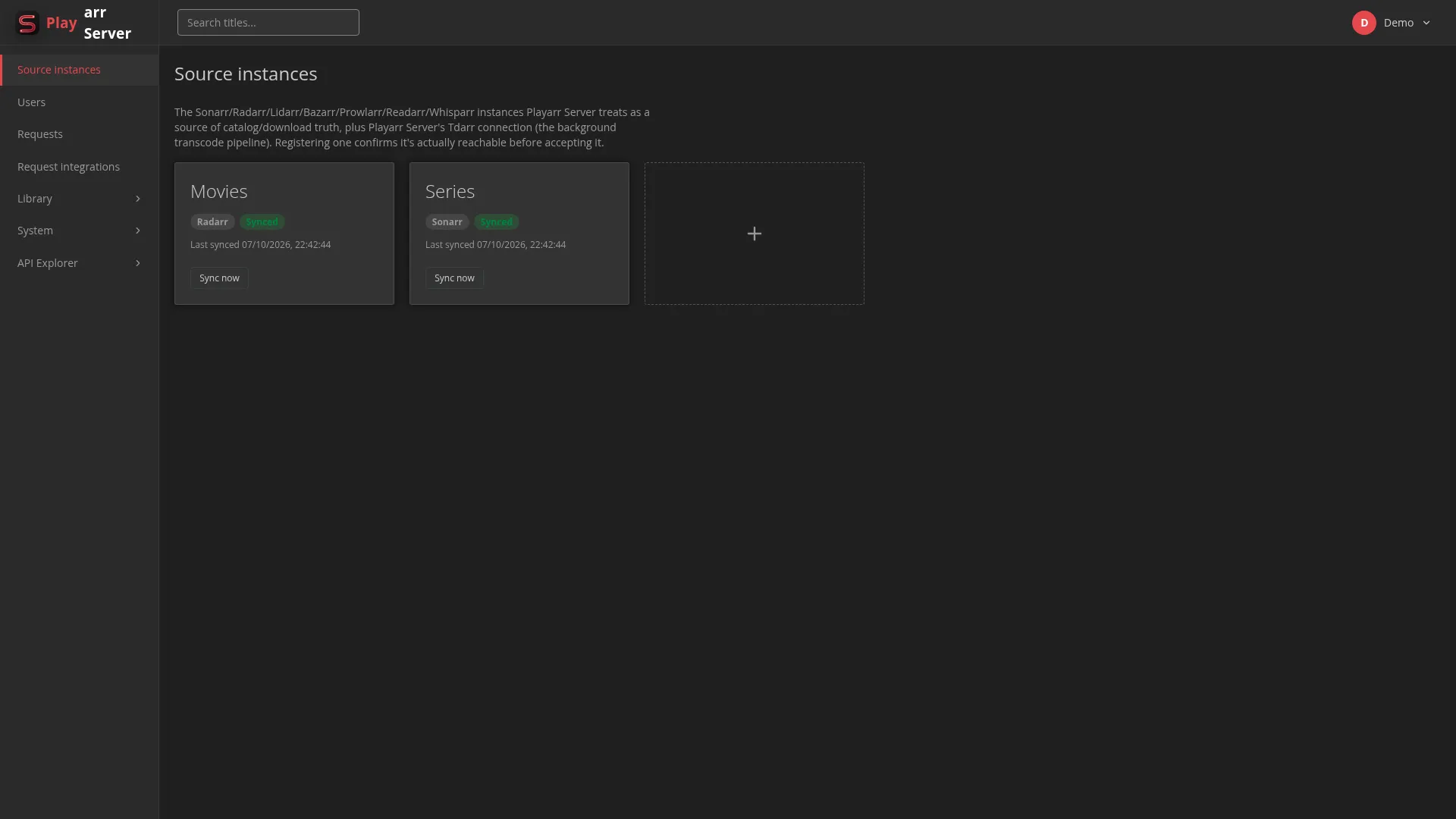
Manage the server centrally
Register the library tools you already run once, and the admin panel keeps the catalogue in sync with every one of them.
Every screen
Playarr, on the devices you already watch on
Fully native clients with full parity and performance: Compose on Android, SwiftUI on Apple platforms, SceneGraph on Roku, and first-class apps elsewhere, all speaking one versioned API contract. Not a single web view in seven wrappers. Features degrade only where capability is missing.
Web
AvailableAny modern browser
Open playarr.app and point it at your server. Nothing to install.
Android
AvailablePhones, tablets, Android TV, Google TV
One signed universal package, installed directly from the clients hub.
Hisense VIDAA
Available · Experimental installVIDAA televisions
Open the web app in the television browser. A launcher tile is experimental.
Roku
Available · Experimental installRoku players and Roku TV
Enable Developer Mode and side-load the package from the clients hub.
LG webOS
Available · Experimental installLG televisions
Build from source, then install with LG Developer Mode and ares-install.
Samsung Tizen
Available · Experimental installSamsung televisions
Build and sign from source with Tizen Studio, then install over sdb.
Apple
Coming sooniPhone, iPad, Apple TV
Native SwiftUI apps exist in the repository; there is no installable build yet.
HarmonyOS
Coming soonHuawei phones, tablets, Vision TVs
A native ArkTS client is in development; there is no installable build yet.
Integrations
Works with the library managers you already run
Playarr reads the library those tools have already organised, the titles, the file paths and the identifiers they resolved. Playarr itself performs no indexing and obtains no media itself.
Sonarr
Series library
Series, seasons and episodes, the file paths they resolve to, and their metadata identifiers.
Radarr
Film library
Films, the file paths they resolve to, and their metadata identifiers.
Lidarr
Music library
Artists, albums and tracks, with their MusicBrainz identifiers.
Readarr
Book library
Authors and books, with their identifiers.
Bazarr
Subtitles
Which subtitle files exist for an item, and in which languages.
Prowlarr
Fleet management
The list of applications it manages, so Playarr can be pointed at them consistently.
Why this one
Things you will not find in the alternatives
Some of these are unusual. All of them are in the repository today.
Federate with a friend, keep your own server
Peer groups let independently owned installations share accounts, permissions and catalogue metadata over a signed protocol, routing playback between each other. Run one server and it stays completely inert.
One binary, Raspberry Pi to Kubernetes
The same executable runs on a NAS, in a container or on a cluster, always against its own embedded SQLite database. More servers join through peer sync, not a shared database.
Pick your own authentication posture
Real accounts by default, or zero-credential auto-login on a trusted LAN if you opt into it, and that opt-in is restricted to private address ranges, so a stray port forward cannot hand over the admin console.
Recommendations that never leave the box
A small CPU-only sentence-embedding model powers "more like this" locally. No cloud API, no generative model, and offline once the model is fetched.
HTTPS without a reverse proxy
Built-in ACME with an HTTP-01 listener, so a home server can hold a real certificate without another moving part in front of it.
The API is part of the product
The OpenAPI description is generated from the handlers, drift-tested in CI and served by the running server. The TypeScript client is generated from it, and so could yours be.
Straight answers
What it does not do yet
Playarr is early. There is no 1.0, nothing is on an app store, and several television clients install through developer mode. Here is what is genuinely missing, so you can decide before you spend an evening on it:
- Hardware-accelerated transcoding, software encoding only for now
- Chromecast and AirPlay
- Live TV, DVR, tuners and programme guides
- Protected-content playback
- A photos library
- Intro and credits detection, trailers and extras, watch-together, plugins
The repository tracks all of this in the open, and the installation guides label anything that is not built yet.
Point it at your library and see.
A single binary and a media path is enough to get a catalogue on screen. The hosted Playarr web app will talk to it as soon as it is running.